
Canton dAppBooster

A local Canton dev loop, end to end.

What an EVM developer gets from a CLI, a browser wallet, and a frontend starter, now for Canton: a local Canton Network stack, wagmi-style hooks, UI components, and CIP-0103 wallet support. Real dApp workflows run on your computer for local development.

→ pnpm dlx dappbooster --canton
Canton Core surrounded by orbiting stack components: DAR, CONNECT, DEMO dApp, dAppBooster, CIP-0103, BAREBONES. DAR CONNECT DEMO dApp dAppBooster CIP-0103 BAREBONES CANTON · CORE
The Stack

Canton dAppBooster gives you

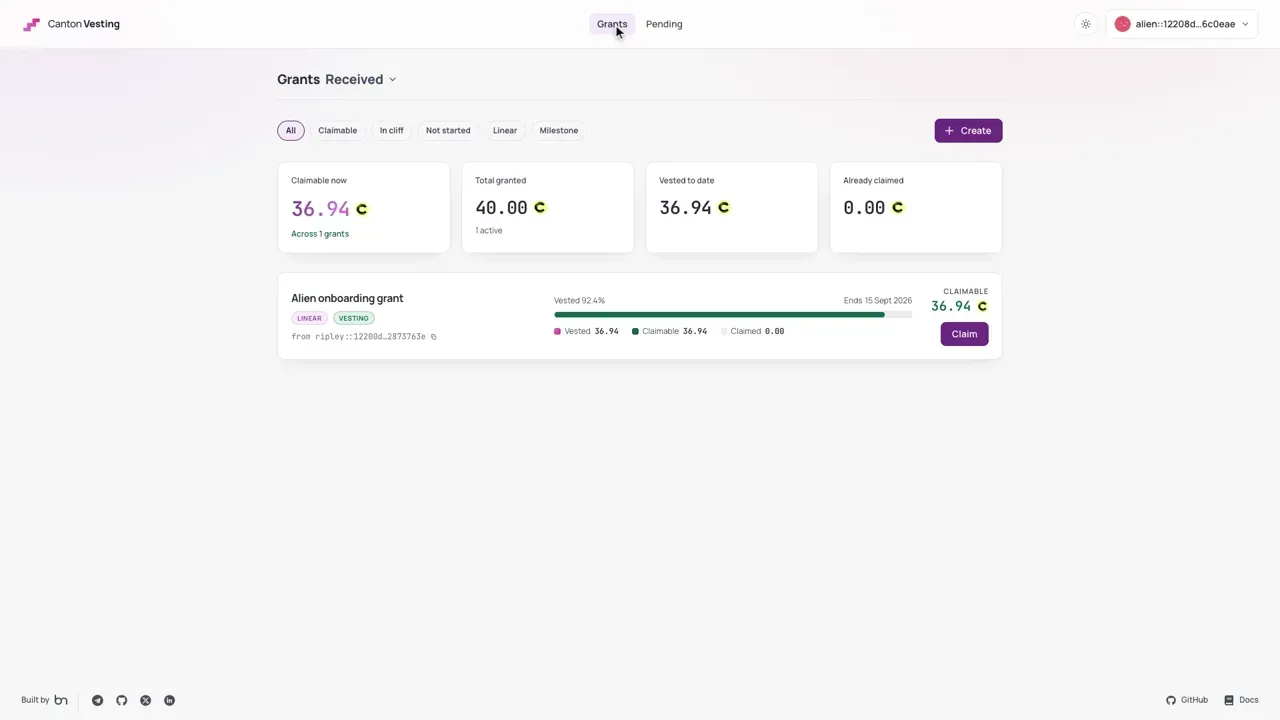
The stack includes an end-to-end demo dApp you can use as a starting point. It exercises every step of the loop: deploy a DAR, connect a wallet, tap the LocalNet faucet, and sign a real Canton transaction.

Local dev loop

How the pieces fit

  1. barebones

    minimal local Canton stack for developer workflows

  2. connect

    wagmi-style React hooks for Canton CIP-0103 wallet connection

  3. dAppBooster

    reusable UI components for Canton dApps

  4. theme

    plain-CSS theme for canton-dappbooster

  5. demo dApp

    a quick starting point for your next Canton project

canton @ dappbooster :~ $ ./scripts/dev-stack.sh up

With the current stack, a developer can:

  • Run a local Canton participant and synchronizer.
  • Deploy DARs.
  • Connect a CIP-0103 compliant wallet.
  • Create external parties from browser-held public keys.
  • Read ledger state as the connected party.
  • Import ready-to-use UI components.
  • Prepare, sign, and execute Canton transactions.
  • Tap the LocalNet faucet.

The goal is fast iteration: write Daml, deploy it locally, connect a dApp, and verify that a real wallet approval flow executes Canton transactions.

Build from

Components

Each piece of the stack runs locally and their open-source nature allows you to fork them to fit your needs.

CO/01

canton-barebones

Runs a local Canton network.

Includes

  • Splice LocalNet
  • Super Validator and global synchronizer
  • app-user and app-provider participants
  • Shared Postgres, Canton and nginx
  • JSON and gRPC Ledger APIs
  • Single JSON config file
  • CLI: start, stop, reset, status, logs
  • Optional Scan, wallet and ANS UIs

Splice is the application stack that runs on Canton Network and ships a ready-made LocalNet.

The scaffolded default is the smallest stack that works: the Super Validator plus a headless app-user validator. Every UI and extra tool is switched off, turn them on as you need them.
CO/02

canton-connect

wagmi-style React hooks.

The dapp-sdk finds a wallet, provides the connect picker, and holds the session over a browser extension, WalletConnect, or a remote gateway. What it does not ship is React: canton-connect is that layer, in the shape an EVM developer expects.

CO/03

canton-dappbooster

Reusable UI components for Canton dApps.

Reusable UI components for common dApp workflows: party id parsing, wallet connect / disconnect, explorer links, token selection and balance, and more.

canton-theme gives them style with plain-CSS. One import for the whole look.

CO/04

demo dApp

An end-to-end Canton dApp that ships with the stack.

The whole loop is wired before you touch it: connect a wallet, tap the LocalNet faucet, run and sign real transactions, then disconnect and come back to it.

It also doubles as the working reference for canton-dappbooster: every blockchain component on screen comes from the kit, styled with canton-theme. You can see how the pieces work and what they look like before wiring them yourself.

The Approach

Two starting points

The official Canton Network Application Quickstart is scaffolding for shipping a real Global Synchronizer application. It ships OIDC login via Keycloak, a Spring Boot backend, PQS and an observability stack, and a good deal more.

That is useful when the goal is to understand the full production-oriented stack.

dAppBooster solves a different problem: a fast Canton dApp development loop.

The two starting points differ in shape

  • Quickstart login Canton user party rights backend-mediated app
  • dAppBooster browser wallet key external party cryptographic signature Canton transaction

Canton dAppBooster simplifies the user layer during local development, so an individual developer can write Daml, deploy a DAR, and execute a real wallet approval flow without standing up Keycloak, a Spring Boot backend, or PQS.

Lineage

Open source and contribute

  • Built on dAppBooster for EVM.

    Canton dAppBooster did not appear out of nowhere. The EVM-side dAppBooster has been shipping and improving with web3 builders for years. The Canton version is built by the same team and applies the same best practices and developer-experience lessons, adapted for the Canton ecosystem. It is open source under the MIT License.

Building dApps with Canton dAppBooster

Frequently Asked Questions

Common questions about what Canton dAppBooster is, how it fits next to the official Canton tooling, and what the local dev loop looks like in practice.